
How Long After Taking Vitamins Can I Drink Tea?
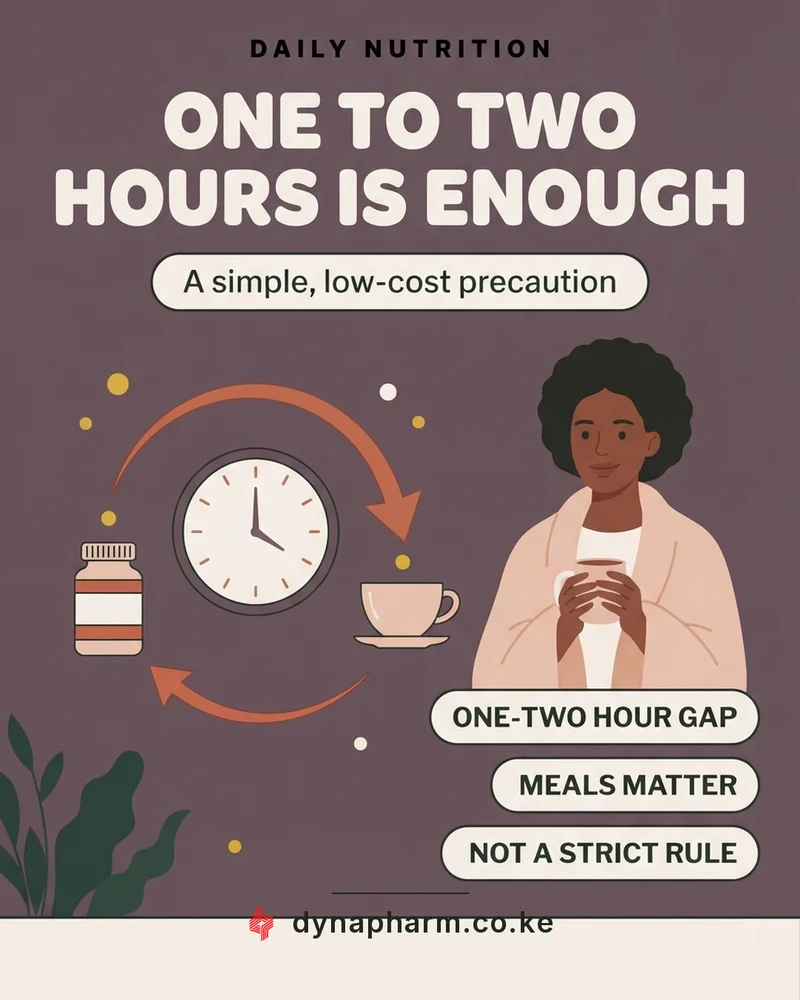
There is no single waiting time that applies to every supplement. The useful rule is to separate tea from iron and calcium, and be relaxed about most vitamins.
How long after taking vitamins can i drink tea
Evidence snapshot
Tea polyphenols can reduce non-haem iron absorption when the two are taken together. The effect depends on the strength of the tea and the meal.
Calcium absorption is less sensitive to tea than iron, but very strong tea with a supplement is still worth separating.
Fat-soluble vitamins A, D, E and K are absorbed with fat and are not known to be blocked by tea.
What to do with this
Wait about one to two hours after an iron or calcium supplement before drinking strong tea. For a multivitamin without iron, take it with food and drink tea whenever you like.
For the specific question "how long after taking vitamins can i drink tea", that means a useful way to judge any nutrition product is to compare its serving with ordinary food. A capsule or a sachet rarely delivers the same amount of a nutrient as a proper meal, and concentrated extracts can behave differently from the whole plant.
Start with the smallest reasonable serving and keep it consistent for a few weeks. If you are tracking a blood result such as iron, vitamin D or B12, repeat the test only when a clinician advises it, because results can fluctuate for unrelated reasons.
Questions people ask
Is one hour enough?
For most people yes. If your iron is low and you drink strong tea with meals, a two-hour gap is safer.
Does milk in tea change this?
Milk may bind some polyphenols, but the effect on iron absorption is not reliable enough to count on.
A common follow-up
Does milk in tea change this? Milk may bind some polyphenols, but the effect on iron absorption is not reliable enough to count on. That context matters when you see broad claims about how long after taking vitamins can i drink tea.
The short answer
Wait about one to two hours after an iron or calcium supplement before drinking strong tea. Nothing here replaces medical care, and persistent symptoms deserve a proper assessment rather than another product.
Sources
Found this helpful? Share it or order on WhatsApp: